

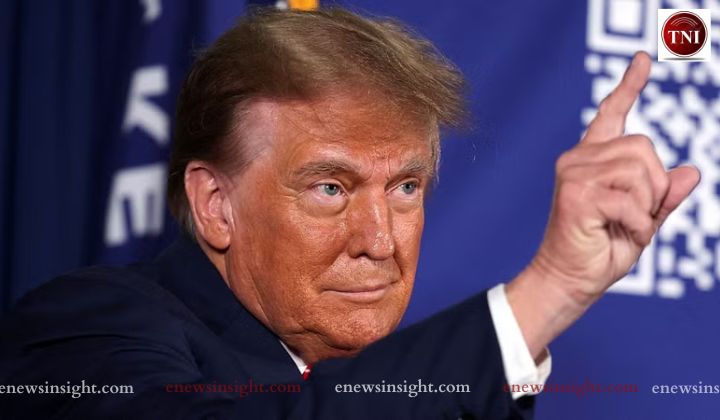
TNI Digital Bureau: US President Donald Trump has said that the United States has “lost India and Russia to darkest China,” reflecting the strain in Washington’s ties with New Delhi. His remarks came days after Prime Minister Narendra Modi was seen with Chinese President Xi Jinping and Russian President Vladimir Putin at the Shanghai Cooperation Organisation (SCO) summit in Tianjin, where their public bonhomie drew international attention.
Posting on Truth Social, Trump wrote, “Looks like we have lost India and Russia to deepest, darkest China. May they have a long and prosperous future together!” His statement followed his administration’s decision to double tariffs on Indian goods to 50 per cent, including an additional 25 per cent levy linked to India’s purchase of Russian crude oil. The measure, effective from August 27, has been described by India as “unfair, unjustified and unreasonable.”
While India has not formally responded to Trump’s post, the Ministry of External Affairs (MEA) rejected recent comments by White House trade advisor Peter Navarro, who accused India of being an “oil money laundromat for the Kremlin.” MEA spokesperson Randhir Jaiswal called Navarro’s remarks “inaccurate and misleading,” adding that India and the US share a “comprehensive global strategic partnership anchored in shared interests, democratic values and people-to-people ties.”
Support Independent Journalism? Keep us live.
India’s crude oil imports from Russia have risen sharply since Western sanctions were imposed on Moscow after its invasion of Ukraine in 2022. From a 1.7 per cent share in 2019–20, Russian oil now accounts for 35.1 per cent of India’s imports, making Russia the country’s largest supplier in 2024–25. India has defended these purchases as being based on national interest and market dynamics.
The Trump administration, however, has not imposed similar punitive measures on China, which remains the largest buyer of Russian oil. This has fueled criticism in New Delhi of Washington’s selective approach.
Despite tensions, the MEA stressed that the relationship with the US remains important and pointed to ongoing joint military exercises in Alaska. On speculation about the future of the Quad summit, Jaiswal said consultations among partners would decide the timing.
The downturn in ties comes after over two decades of close cooperation, highlighting deepening differences on trade and energy security.
Comments are closed.