

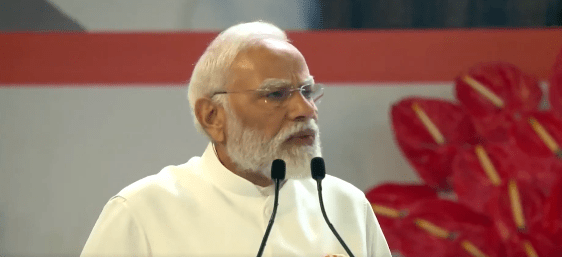
New Delhi: Prime Minister Narendra Modi on Friday inaugurated the year-long celebration marking 150 years of India’s national song, Vande Mataram, at the Indira Gandhi Indoor Stadium in New Delhi. Speaking at the event, he said that during the period of colonial rule, Vande Mataram became the voice of India’s awakening and symbolised the spirit of freedom and self-respect.
The Prime Minister said that India’s civilisation has always evolved through learning and reflection. “From the eternal journey of humankind, we have drawn lessons that shaped our values and ideals. Our sages and ancestors gave us a distinct cultural identity,” he noted.
Explaining the historical importance of the national song, PM Modi said that Vande Mataram represented India’s determination to free itself from bondage. “It was not just a song—it was a declaration that the chains holding Maa Bharati would be broken by her own children,” he said.
Quoting the opening lines of the song — ‘Sujalam suphalam malayaja shitalam shasyashyamalam Mataram’ the Prime Minister said it reflects the beauty and prosperity of the Indian land, which has always had the power to nurture and sustain life.
PM Modi recalled that Vande Mataram was first published in 1875 by Bankim Chandra Chatterjee in the literary journal Bangadarshan, as part of his novel Anandamath. “At first, many thought it was only a literary work, but it soon became the collective voice of India’s awakening and the united call of millions striving for freedom,” he said.
Support Independent Journalism? Keep us live.
The Prime Minister highlighted that Bankim Chandra envisioned a strong and prosperous India even during difficult times marked by poverty and despair. “He believed that India would regain its golden era, and that belief took the form of Vande Mataram,” Modi said.
He also mentioned how freedom fighters used Vande Mataram as a slogan of unity and courage. “Leaders like Veer Savarkar and other revolutionaries greeted each other with Vande Mataram. Many even shouted these words on the gallows,” he said.
According to the Prime Minister’s Office, the song was composed by Bankim Chandra Chatterjee on Akshaya Navami, November 7, 1875. It describes the Motherland as a symbol of strength, prosperity, and divinity. Over time, it became one of the most powerful expressions of India’s unity and patriotism.
Earlier this year, the Union Cabinet approved nationwide celebrations to mark the 150th anniversary of Vande Mataram. The initiative aims to connect people, especially youth and students, with the song’s original spirit of nationalism and devotion.
Alongside the Vande Mataram anniversary, the BJP has planned events to mark another major milestone, the 150th birth anniversary of tribal leader and freedom fighter Bhagwan Birsa Munda.
Comments are closed.