
Volcanic ash exits India; flights hit as Ethiopia’s Hayli Gubbi volcano erupts after 10,000 years

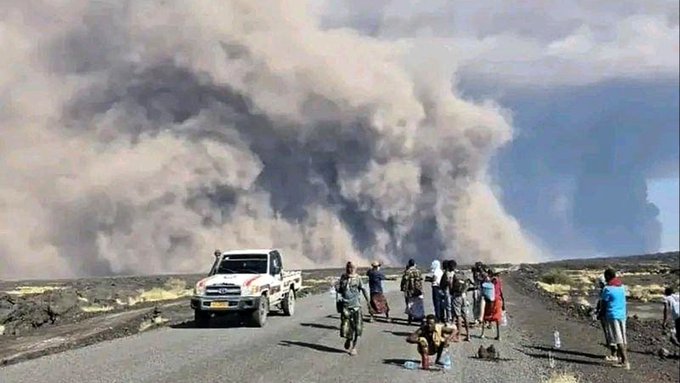
TNI Bureau: Flight operations across several parts of India were disrupted on Monday and Tuesday after a massive ash cloud from Ethiopia’s Hayli Gubbi volcano drifted across the Arabian Sea and swept over western and northern states. The plume, however, exited India by 8:30 pm on Tuesday, except for some parts of the Northeast, according to the India Meteorological Department (IMD).
The Hayli Gubbi volcano in Ethiopia’s Afar region erupted early Sunday, its first eruption in 10,000 years, blanketing the nearby village of Afdera in dust and sending ash plumes across the Red Sea toward Yemen, Oman and further east.
Residents near the volcano described the explosion as violent. “It felt like a sudden bomb had been thrown with smoke and ash,” said Ahmed Abdela, a resident quoted by AP, adding that the region is seismically active.
Indian aviation authorities said the drifting ash cloud affected several flight routes, causing cancellations, delays and altitude adjustments as a precaution. The Directorate General of Civil Aviation (DGCA) advised airlines to avoid affected airspaces, while carriers such as IndiGo, Air India and Akasa Air assured passengers that safety remained the priority.
Support Independent Journalism? Keep us live.
The ash mass first entered Gujarat on Monday before spreading across Rajasthan, Maharashtra, Delhi-NCR, Haryana and Punjab through the night, briefly disrupting operations at several airports.
The Civil Aviation Ministry said that despite the temporary disruptions, “operations across India remain smooth, with only a few flights rerouted or descended as a precaution.” It added that there remains no cause for concern, as close coordination continues between the ministry, air traffic control, IMD and global aviation agencies.
Satellite observations showed the ash drifting in the middle and upper troposphere, with no impact on surface weather or air quality in India, officials said. The IMD confirmed that the plume is now moving out of India and progressing towards China.
The Tokyo Volcanic Ash Advisory Center (VAAC), one of nine global centers responsible for tracking volcanic ash worldwide, has taken over monitoring of what aviation trackers have called a major “ash event.” New satellite imagery from the EU Copernicus Sentinel-5P also captured the continuing activity at Hayli Gubbi on Monday, a day after the eruption began.
As the ash cloud clears Indian skies, aviation authorities said they will continue monitoring developments for any further impact on flight operations.
Comments are closed.