

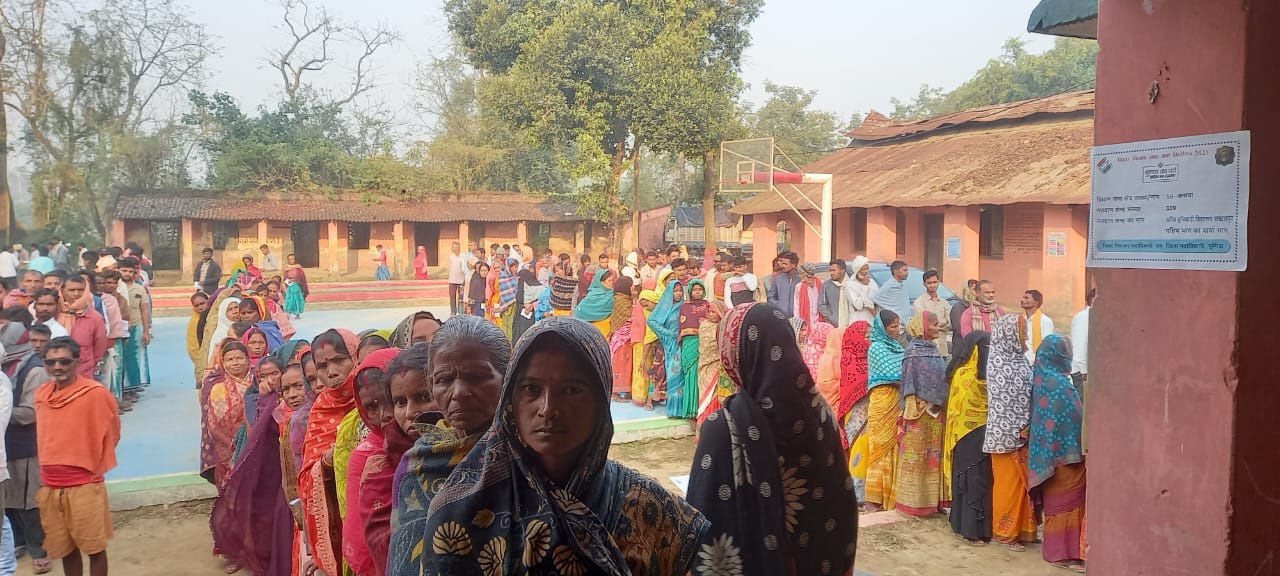
TNI Bureau: Bihar witnessed its highest-ever voter turnout on Tuesday, recording 68.95 per cent polling as of 10:30 PM in the second and final phase of the 2025 Assembly elections, marking an all-time high in the state’s electoral history. The turnout numbers are likely to increase later.
The massive participation across 122 constituencies, with 3.70 crore eligible voters, is being viewed as a referendum on Chief Minister Nitish Kumar — the state’s longest-serving leader — as he seeks another term under the BJP-led National Democratic Alliance (NDA).
According to the Election Commission of India’s updated figures released late in the evening, the turnout surpassed the “record” 65.09 per cent achieved in the first phase held on November 6. Officials said the number could rise further, as voters standing in queues at several polling booths were allowed to cast their votes beyond the scheduled closing time of 5 pm.
Kishanganj, the lone Muslim-majority district in Bihar, registered the highest voter turnout so far at 76.26 per cent, followed by Katihar (75.23 per cent), Purnea (73.79 per cent), Supaul (70.69 per cent), and Araria (67.79 per cent). These districts — mostly located in the flood-prone Kosi-Seemanchal region bordering Nepal — witnessed heavy participation, with minorities playing a key role in the electoral dynamics. High turnouts were also reported from southern Bihar districts such as Jamui (67.81 per cent), Gaya (67.50 per cent), and Kaimur (67.22 per cent), while Nawada recorded the lowest turnout at 57.31 per cent.
The polling marked the culmination of a fiercely contested two-phase election that saw 1,302 candidates, including eight ministers in the Nitish Kumar cabinet, vying for seats. While the Chief Minister himself is a member of the Legislative Council and did not contest directly, the outcome is being seen as a test of his administration’s “good governance” record.
Prime Minister Narendra Modi and Chief Minister Nitish Kumar had earlier appealed to voters to set a new record in polling, calling voting both a right and a civic duty. “I urge all voters, especially the youth voting for the first time, to participate enthusiastically and inspire others to do so,” the Prime Minister posted on X. Nitish Kumar echoed the sentiment, describing voting as “not only our right but also a responsibility.”
The final phase covered several border districts such as West and East Champaran, Sitamarhi, Madhubani, Supaul, Araria, and Kishanganj, many of which have a significant Muslim population. The region turned into a key battleground between the ruling NDA, which has accused the opposition of shielding “infiltrators,” and the opposition INDIA bloc, which banks heavily on minority support.
As polling concluded, the spotlight quickly shifted to exit poll results, which uniformly predicted a decisive win for the NDA and another term for the Nitish Kumar-led alliance. Across major agencies, the ruling coalition was projected to cross the majority mark comfortably, while the opposition Mahagathbandhan (MGB), comprising the Rashtriya Janata Dal (RJD), Congress, and Left parties, was placed at a distant second.
According to Matrize, the NDA is likely to win between 147 and 167 seats, while the MGB is projected to secure 70–90 seats. Peoples Pulse predicted a similar outcome, giving the NDA 133–159 seats, the MGB 75–101, and Prashant Kishor’s Jan Suraaj (JSP) 0–5 seats. P-Marq estimated 142–162 seats for the NDA, 80–98 for the MGB, and 1–4 for JSP. Dainik Bhaskar projected 145–160 seats for the NDA, 73–91 for the MGB, and 0–3 for JSP. Chanakya Strategies forecast a tighter race, giving the NDA 130–138 seats and the MGB 100–108.
Party-wise projections varied across agencies but pointed to an overall edge for the BJP and JD(U). P-Marq’s breakdown suggested BJP could win 68–78 seats, JD(U) 62–72, and RJD 63–79. Congress was projected between 9–19, while Jan Suraaj, contesting its first election, was expected to get 1–4 seats. Smaller allies like LJP (Ram Vilas), RLM, VIP, and Left parties were forecast to win marginally in single digits.
People’s Insight projected BJP with 68–72 seats, JD(U) 55–60, and LJP 9–12, while RJD could get 65–72, Congress 9–13, and Left 11–14. Polstrat gave the NDA 133–148 seats and MGB 87–102, maintaining the same trend of a comfortable NDA lead.
The INDIA bloc, however, remains hopeful that the high turnout in minority-dominated areas might tilt results in their favour. Congress, which had won 19 seats in the 2020 assembly polls, saw 12 of its sitting MLAs recontesting this phase, including state president Rajesh Kumar Ram (Kutumba) and Shakeel Ahmed Khan (Kadwa).
Meanwhile, Jan Suraaj founder Prashant Kishor, once a key strategist for both Nitish Kumar and Narendra Modi, claimed that the surge in voter turnout signified Bihar’s search for an alternative. “The people who once felt trapped between two old choices are now seeing hope in our movement,” he said, calling migrant labourers the “X factor” of the election.
The 2025 Bihar Assembly elections were conducted in two phases, with the first held on November 6 and the second on November 11. A total of 243 constituencies went to polls, and the majority mark to form the government stands at 122 seats. The results will be declared on November 14.
As Bihar awaits the verdict, political watchers believe that this record-breaking turnout, coupled with the high-stakes contest between continuity and change, could redefine the state’s political landscape. For now, all eyes remain on the NDA, widely tipped to retain power, as the state braces for counting day.
Support Independent Journalism? Keep us live.
Comments are closed.