

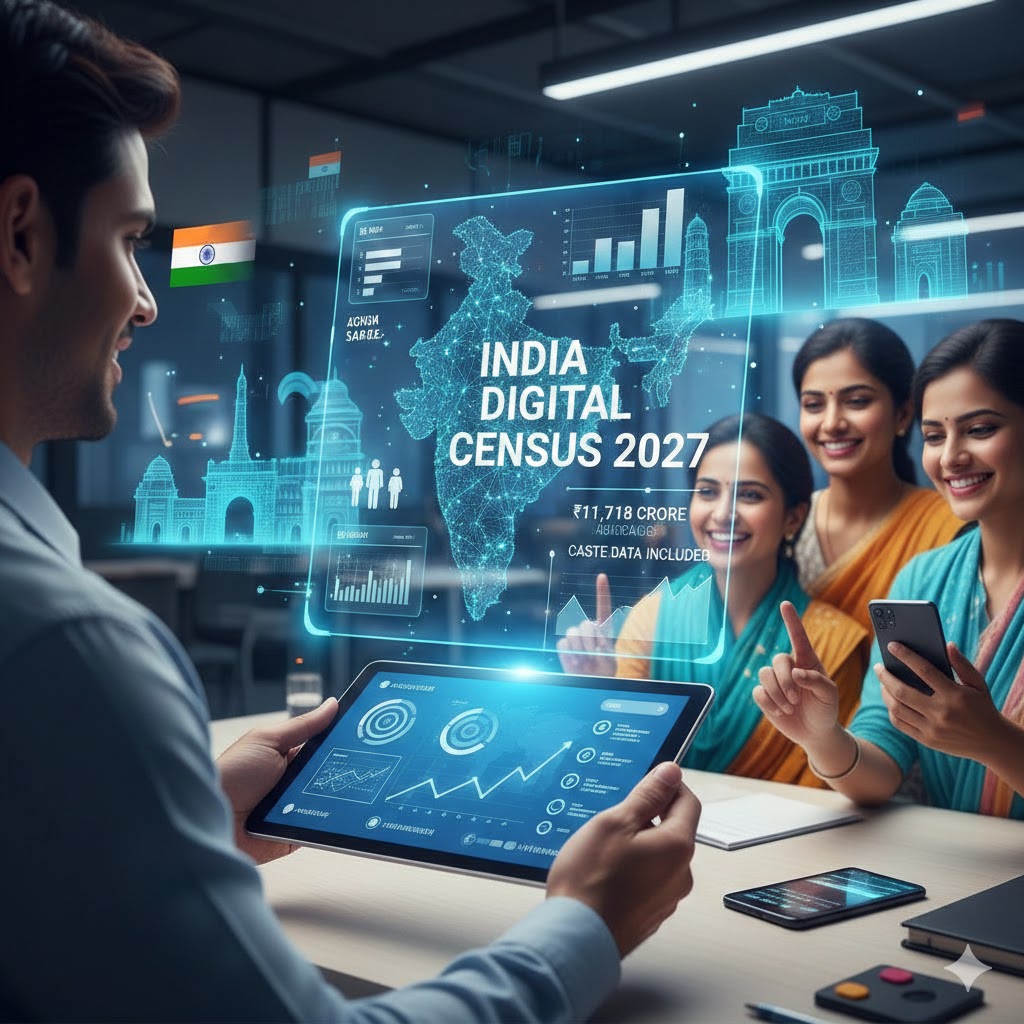
New Delhi: In a major decision, the Union Cabinet on Friday approved ₹11,718.24 crore for conducting Census 2027, which will become India’s first fully digital population count and the world’s largest administrative exercise. The announcement was made after the Cabinet meeting chaired by Prime Minister Narendra Modi.
The Census, traditionally carried out every 10 years, was last scheduled for 2021 but postponed due to the COVID-19 pandemic. The upcoming 2027 exercise will be the 16th Census of India and the eighth since Independence.
Digital-first approach
For the first time, all data will be collected digitally through mobile applications available for Android and iOS devices. A central portal, the Census Management and Monitoring System (CMMS), will track the entire process in real time. Officials say this will allow faster compilation and quicker release of results.
Another new tool, the Houselisting Block Creator, will help officials map areas digitally. Citizens will also have the option of self-enumeration.
The government says the goal is to provide clean, machine-readable, and instantly usable data under a new model called “Census-as-a-Service (CaaS)”, which will help ministries retrieve information for policymaking at the click of a button.
Two-phase schedule
The Census will be carried out in two phases:
-
Phase I: Houselisting and Housing Census – April to September 2026
-
Phase II: Population Enumeration – February 2027 (reference date: March 1)
In snow-bound regions such as Ladakh, Jammu & Kashmir, Himachal Pradesh, and Uttarakhand, the Population Enumeration will be done earlier, in September 2026.
Caste data to be collected
Support Independent Journalism? Keep us live.
For the first time in independent India, the Census will also include caste enumeration, following a decision by the Cabinet Committee on Political Affairs earlier this year. This data will be captured electronically during Phase II.
Manpower and employment
The massive operation will engage around 30 lakh field staff, including enumerators, supervisors, master trainers, and district-level officers. Enumerators, mostly government teachers, will take up Census duties in addition to their regular work and receive honorariums.
The government estimates the exercise will generate 1.02 crore man-days of employment, along with hiring 18,600 technical personnel for 550 days to manage digital systems at local levels.
No dedicated budget for NPR this time
Unlike 2019, the government’s statement made no mention of funds for updating the National Population Register (NPR). The NPR, last updated in 2015, had previously been aligned with the first phase of the Census. NPR data, which is organised family-wise, can be shared with Government agencies, but Census data, protected by the Census Act, 1948, can only be released in aggregated form.
Why the Census matters
Census data serves as India’s most important source of primary information at the village, town, and ward levels. It provides detailed insights into:
-
Housing conditions and amenities
-
Religion, caste, language
-
Literacy and education
-
Employment and economic activity
-
Migration and fertility patterns
The government says the new digital format aims to cut down processing time and release results faster, with improved visualisation tools for public and policy use.
Union Minister Ashwini Vaishnaw, briefing the media, called it “India’s first-ever digital Census” and said the renewed approach would make the entire process more transparent, efficient, and participatory.
Comments are closed.