
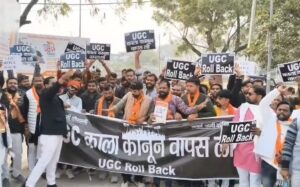
TNI Bureau: The University Grants Commission (UGC) row has emerged as one of the most contentious higher-education debates in India in early 2026. At the centre of the controversy are the newly notified Promotion of Equity in Higher Education Institutions Regulations, 2026, introduced on January 13, 2026, to replace the older 2012 anti-discrimination framework.
The regulations aim to curb caste-based and other forms of discrimination on university and college campuses by making anti-bias mechanisms mandatory, with institutions required to establish Equal Opportunity Centres, Equity Committees, 24×7 helplines and structured grievance redressal processes. The intention, according to UGC, is to promote inclusive and equitable learning environments in line with constitutional principles of social justice.
However, widespread protests and organised pushback quickly followed. A key source of agitation has been students and social groups—particularly from upper-caste or general categories—who argue that the new regulations could inadvertently result in reverse discrimination.
Critics contend that the operational definition of caste-based discrimination focuses on protections for Scheduled Castes (SC), Scheduled Tribes (ST) and Other Backward Classes (OBC) while excluding general category students from equivalent access to grievance mechanisms, thus potentially compromising fairness. Many also highlight the absence of strong safeguards against false or malicious complaints and broad, ambiguous enforcement mechanisms that could be misused, fueling campus tension rather than harmony.
The backlash has taken multiple forms: campus protests at institutions like Lucknow University; political resignations from student and party leaders; a Public Interest Litigation (PIL) challenging the rules in the Supreme Court; and heightened social media debate. Some opponents have even labelled the guidelines ‘black law’ and raised concerns about institutional autonomy and procedural fairness.
Government leaders, including the Union Education Minister, have stepped in to clarify that the regulations will be implemented fairly and within constitutional bounds, assuring that no discrimination or misuse will be permitted. Yet, the row continues to highlight deeper debates over how best to balance equity, due process and institutional freedom in India’s diverse higher-education landscape.

