
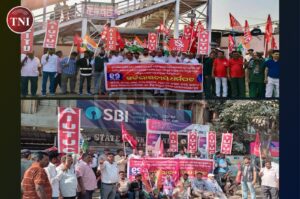
TNI Bureau: Normal life was disrupted across Odisha as several central trade unions observed a nationwide strike (Bharat Bandh) protesting against policies of the Union Government. The bandh affected road transport, rail services, markets and educational institutions in various districts.
In Bhubaneswar, labour union members locked the ‘Ama Bus’ depot at Master Canteen and staged a protest at the entrance, halting bus operations from the facility. Protesters also blocked roads at Master Canteen Square and staged a blockade on NH-16 near the Jaydev Vihar flyover, leaving hundreds of vehicles stranded on both sides.
The impact of the bandh was also visible at the Netaji Bus Terminal in Cuttack, where bus services were affected.
In Sundargarh district’s Bonai area, the bandh had a significant impact in Rajamunda and Patsahi, where markets remained closed and vehicles stayed off the roads. The protest was led by CPI(M) MLA Laxman Munda. CPI(M) and CITU activists also blocked railway tracks at Bimlagarh, disrupting train services.
At Balasore railway station, trade union members staged demonstrations and stopped the Bangiriposi–Puri Express. Protests were also reported from different parts of Balasore town.
In Bolangir, agitators locked the district head post office and staged a demonstration, while the morning vegetable market remained closed. In Bhadrak, members of AICCTU blocked NH-16 near College Chhak, affecting vehicular movement.
In Berhampur, labour union members held a sit-in at the railway station, and several private educational institutions remained closed. In Paradip, workers demonstrated in front of Gate No. 3 of the port, with protests also reported near Rangia Garh Bridge, Trilochnapur road and Kujang market.
In Jajpur, protesters blocked the Medical Chowk Road as part of the strike.
In Sambalpur, protesters blocked NH-55 at Ainthapali Chhak, and shops and markets in different parts of the city remained closed.
Across many parts of the state, shops, business establishments and educational institutions were shut due to the bandh. However, emergency services, including ambulance operations, were exempted.
The central trade unions called the strike alleging that the Union Government has introduced anti-people legislation and policy measures. They opposed the replacement of the Mahatma Gandhi National Rural Employment Guarantee Act and demanded the repeal of the four labour codes enacted by the Centre, describing them as anti-labour.

 protesting against policies of the Union Government. The bandh affected road transport rail services markets and educational institutions in various districts.)